
Picturing Your Perfect Vinyl Fence in Spring Hill?
Talk to us about what you’re thinking
Free estimates • Licensed and insured • Locally owned
Serving Spring Hill, FL
Is Vinyl Fencing the Right Choice for Your Spring Hill Property?
A lot of homeowners land on vinyl fencing after looking at the alternatives and doing the math. Wood needs painting, staining, and resealing on a schedule that adds up over time. Metal rusts. Chain link gets the job done but doesn’t look like much. Vinyl sidesteps most of those problems, it doesn’t rot, doesn’t rust, doesn’t need painting, and holds its color without much attention from you. In Spring Hill’s humidity, that matters more than it would in a drier climate where wood holds up more forgivingly.
What a lot of people don’t realize until they start looking is how much variety vinyl actually comes in. It’s not just white picket fences anymore. Vinyl is available in a range of colors including white, tan, gray, and wood grain textures that do a reasonable job of mimicking the look of natural wood without the maintenance that comes with it. For homeowners in communities like Sterling Hill or Pristine Place where HOA appearance standards specify color and style, vinyl is often the easiest material to work with since manufacturers produce styles specifically designed to meet common community requirements. If your HOA has approved color guidelines, we help you match what’s already in the neighborhood before anything gets ordered.
The tradeoff people don’t always think about upfront is that vinyl needs to be installed correctly the first time. Unlike wood where a slightly off post can be adjusted as you go, vinyl panels are manufactured to precise dimensions and the posts need to be set at exact spacing, depth, and alignment before a single panel goes on. In Spring Hill’s sandy soil, that matters more than it would on a firmer lot. For a broader look at how local soil and conditions affect material choices in Spring Hill, our Spring Hill fence installation page covers that before you commit to anything.
What Vinyl Fencing Actually Looks Like in Spring Hill
Vinyl holds its appearance in Spring Hill’s climate in a way that some other materials struggle with. It doesn’t absorb moisture, doesn’t fade the way painted wood does in full sun, and doesn’t need annual attention to keep looking right. A properly installed vinyl fence in Spring Hill should look essentially the same ten years from now as it does the day it goes in, which is genuinely not something you can say about wood or bare metal out here.
The color stability is one of the things homeowners notice most after a few years. Modern vinyl is manufactured with UV inhibitors built into the material rather than applied as a coating, which means the color doesn’t peel or fade the way paint does. White stays white, tan stays tan, and wood grain textures hold their appearance without the graying and weathering that actual wood goes through without consistent sealing. For communities where appearance standards are actively enforced, that consistency is one of the practical arguments for vinyl over wood.
Vinyl is also one of the more versatile materials for pool enclosures and backyard privacy applications. It’s available in heights from four feet up to eight feet depending on the application, and the privacy panel style eliminates sight lines completely when installed correctly. For homeowners in Timber Pines or Berkeley Manor where pool safety and backyard privacy are the main drivers, vinyl gives you both without asking much from you in return.
What Most People Don’t Know About DIY Vinyl Fence Installation
Vinyl looks straightforward until you’re actually doing it. The panels are heavy, the post spacing has to be precise, and once the concrete sets around a post that’s even slightly out of alignment you’re either living with it or starting that section over. A few things that catch people off guard out here specifically:
Post holes in Spring Hill’s sandy soil need to go deeper than the general recommendation since loose ground doesn’t grip a post the way compacted clay does. Most professionals set posts for a six-foot fence at least three feet down with a concrete footing that’s sloped away from the post base to drain water rather than pool around it. Skip that step and you’re resetting posts within a couple of years.
Vinyl expands and contracts with temperature, which is a bigger deal in Spring Hill’s heat than in cooler climates. Panels need expansion gaps between them or they buckle in summer heat. Most first-time installers don’t know this exists until they see their fence warping after the first hot season.
Sloped ground adds a layer of planning most people don’t account for. A flat backyard is one thing. Anything with even a moderate grade needs either a stepped or racked installation, both of which require precise measurements and planning before a single post goes in the ground. Get it wrong and you’ve got gaps at the bottom that your dog figured out how to use before you even finished the job.
And before any digging happens, call 811. Utility lines run through more Spring Hill yards than people realize and hitting one while digging post holes is an expensive and dangerous mistake that’s completely avoidable.
The Three Main Vinyl Fence Styles
Vinyl Privacy Fencing
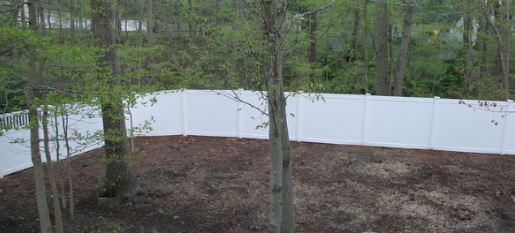
Privacy vinyl is the most common choice for backyards in Spring Hill, and for good reason. Six-foot privacy panels give you complete visual coverage, hold up well in the humidity, and look clean and consistent year after year without any maintenance. It’s the right call if you want your backyard to actually feel private rather than just technically fenced. Available in white, tan, gray, and wood grain textures depending on your preference and your community’s requirements.
Vinyl Picket Fencing
Vinyl picket is the classic front yard option, the clean look without the painting and maintenance that a wood picket requires. It works well for defining a front boundary or a garden area without creating a visual wall, and it holds its appearance in Spring Hill’s sun without fading or peeling. For neighborhoods where HOA appearance standards apply, white vinyl picket tends to satisfy community requirements cleanly while still looking intentional rather than generic.
Vinyl Ranch Rail
Ranch rail is the low-maintenance choice for larger properties where you want a boundary without full privacy coverage. It comes in two, three, and four rail configurations and works well for defining a yard perimeter, a garden boundary, or a larger lot where a full privacy fence would feel visually heavy. Available in white and tan to match most community color standards.
Vinyl for Commercial Properties
Vinyl isn’t just a residential material. We install vinyl fencing for businesses and commercial properties throughout Spring Hill where a clean, low-maintenance perimeter makes sense. Vinyl holds up well in commercial settings without the rust and corrosion issues that come with bare metal out here, and it doesn’t require the ongoing painting and sealing that wood needs to stay looking professional. For storage facilities, parking areas, and commercial properties where appearance and low maintenance both matter, vinyl is worth considering alongside chain link and aluminum fencing as alternatives depending on the security requirements.
Frequently Asked Questions
Does vinyl fencing hold up in Spring Hill’s heat and humidity?
Yes, and it actually does better in Spring Hill’s climate than wood does in a lot of situations. Vinyl doesn’t rot, doesn’t absorb moisture, and doesn’t need sealing or painting to maintain its appearance. The one thing to know is that it does expand slightly in high heat, which is why proper installation with expansion gaps between panels matters more out here than in cooler climates.
My vinyl fence is starting to sag or bow between posts. What causes that?
Usually one of two things: posts that weren’t set deep enough and have shifted in Spring Hill’s sandy ground, or panels that were installed without proper expansion gaps and have buckled in the heat. Sometimes it’s both. We’d take a look at the posts first since that’s usually the root cause. A fence that’s sagging at the panels but has solid posts is a much easier fix than one where the posts themselves have moved.
How long does a vinyl fence actually last?
A properly installed vinyl fence in Spring Hill should last 20 to 30 years with minimal attention. The keyword is properly installed. Vinyl that goes in with shallow posts, no expansion gaps, or wrong post spacing can start showing problems within a few years. The installation is where the longevity is determined, not the material itself.
Can vinyl fence panels be replaced individually if one gets damaged?
Yes, individual panels can usually be replaced without pulling out posts or replacing whole sections. The panel slides out of the rails and a new one slides in. It’s one of the practical advantages vinyl has over wood, where a damaged section often means dealing with nails, rot, and boards that don’t match anymore.
Do I need a permit to install a vinyl fence in Spring Hill?
It depends on which side of Spring Hill you’re in and how the fence is being installed. In Hernando County most fence projects require a permit. In Pasco County a standard residential fence without concrete footers is typically exempt, but fences with concrete footers or masonry columns do require one. Either way, HOA and deed restriction requirements apply on top of county rules if your neighborhood has them. We help you figure out what applies to your specific property before we start.
Is vinyl fencing a good choice for a pool enclosure?
Vinyl can work for pool enclosures but aluminum is generally the more practical choice for that specific application. Pool barrier code has specific requirements for height, gate latch type, and visibility that aluminum satisfies more cleanly. For a standard backyard privacy fence that’s separate from a pool enclosure, vinyl is a strong choice. Learn more about aluminum fencing if a pool enclosure is what you’re after.
My HOA has specific color and style requirements. Can you match them?
Yes. Before anything gets ordered we confirm what your community allows and make sure the material, color, and style we’re proposing will pass the approval process. The last thing you want is a fence that gets installed and then flagged by the HOA for a color or style that wasn’t on the approved list.
Contact Fence Installation of Spring Hill Today!
If you’re in Spring Hill and ready to talk about a vinyl fence for your property, give us a call. We’ll take a look at your lot, walk you through your style and color options, and give you a straight answer about what works for your specific situation, no pressure, no overselling.